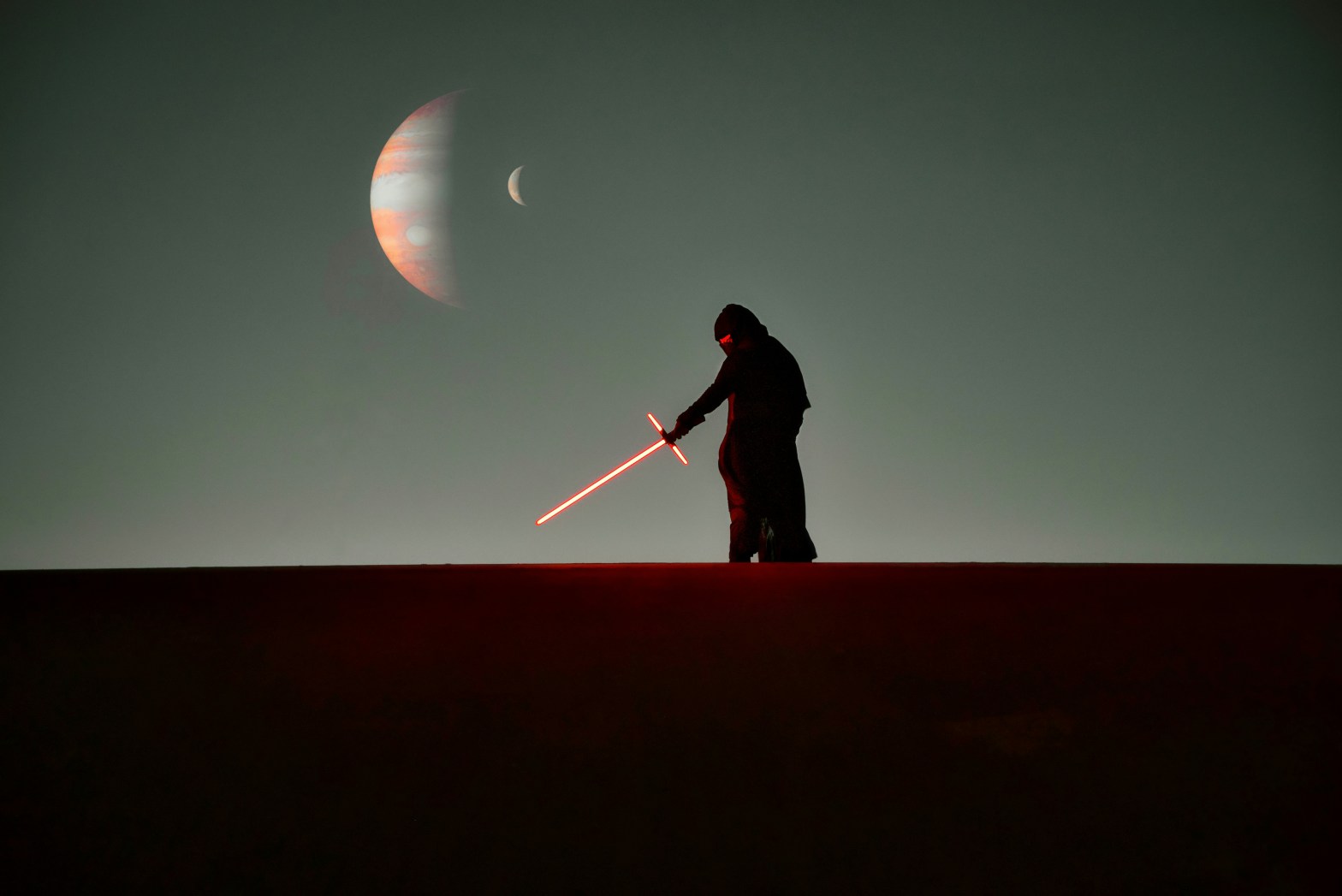
In 1977’s A New Hope, a well-known deleted scene depicts Luke Skywalker looking through a pair of telescopic binoculars while observing the battle between the Alliance and the galactic Empire as it unfolds across a celestial battlefield. There’s also a reference to that moment in the opening of The Last Jedi when a Resistance member looks up and can see the extra-terrestrial conflict between the First Order and the remnants of the Alliance. In the book of Genesis, the patriarch Abram is told to look up at the stars and through this simple gesture, God communicates and translates His gracious promises to His people (inasmuch as they are inculcated in Abram). This also foreshadows a reality on which St John expounds in the Apocalypse, namely a revelation of the conclusion of the redemptive narrative just as the forthcoming 9th Star Wars film The Rise of Skywalker signals the conclusion of the Star Wars saga.
In Revelation 12, we see the depiction of a true battle in the heavens: Christ ascends having atoned for the world’s sins, the accuser (satan) is kicked out of heaven, and a war ensues ultimately between Law and Grace. I connect with this real story the beloved Apostle portrays through symbolic, graphic novel-esque imagery because stories are God’s chosen vehicle for alluding to the mystery, Truth, and beauty of who He is. This is one reason cinema is such a powerful medium and why novels, legends, folktales, ballads, and narratives are the very lifeblood of any culture. If you want to find out something about a society, listen to their stories, listen to their legends, listen to their folklore…it’s how we perpetuate legacies and preserve identities and cultural integrity. Even the theologies a culture creates to explain the origins of the universe and their relation to it reside implicitly and explicitly in the stories they tell and transfer to subsequent generations.
One of the things I anticipate most about the final chapter of the Skywalker legacy is finding out how director JJ Abrams will wrap up the story-line and arrive at closure to a nine-episode arc. Similarly, I want to find some closure and make sense out of God’s narrative that perpetually remains larger than (though doesn’t preclude) my story. I enjoy sinking down in plush seats in a darkened theater facing a larger-than-life screen, engulfed in a narrative bigger than myself. Namely, because something in me internally registers with an iconic, timeless transcendent parable and for those 3 hours, I remember there is a grand meta-narrative that defines my present context in this age.
While we are still at least a month out from Rise of Skywalker‘s release date, we don’t have to wait to figure out what happens in the end of The ultimate and most true story whence derive all epic stories. We don’t have to wait to find out how the problem of universal evil will be resolved in the end. The Bible tells us as Christians we have the privilege of working backwards i.e. working out from the redemption we already have. We know the ending of the story and in the economy of God, the ending has already occurred…we won before we had a chance to start…but we still need to be reminded daily that the battle is already won. Abram looked up in faith and saw the stars in the heaven – he saw a prophetic indication of God’s promise that was yet to be fulfilled. We who have the promise, can look at the Man who was lifted up (cf. John 12:32)… namely, the Christ whose righteousness has become our story…now and forever.
 Law, Grace, & Daily Living